














Course overview
The Entry Certificate in Business Analysis (ECBA) is the first step for anyone looking to start a career in business analysis. At Nexus Adv, our ECBA certification training course is designed not only to prepare you for the official IIBA ECBA exam but also to give you the practical skills hiring managers expect from entry-level business analysts.
Unlike standard theory-based programs, our course focuses on situational learning, application of the Business Analysis Core Concept Model (BACCM), and practice with real-world cases. With access to ECBA exam questions, practice tests, and hands-on exercises, you’ll build the confidence to succeed both in the exam and in the workplace.Learn more
What makes Nexus Adv unique is the expertise of our instructor. Led by experienced business analysis professional who have guided dozens of candidates to certification success, our training ensures that you gain both knowledge and applied skills. You won’t just memorize concepts, you’ll learn how to use them in real projects.
Whether you’re a student, career changer, or professional aiming to enhance your qualifications, our ECBA training program gives you the foundation to launch your career in business analysis and achieve your IIBA ECBA certification with confidence.
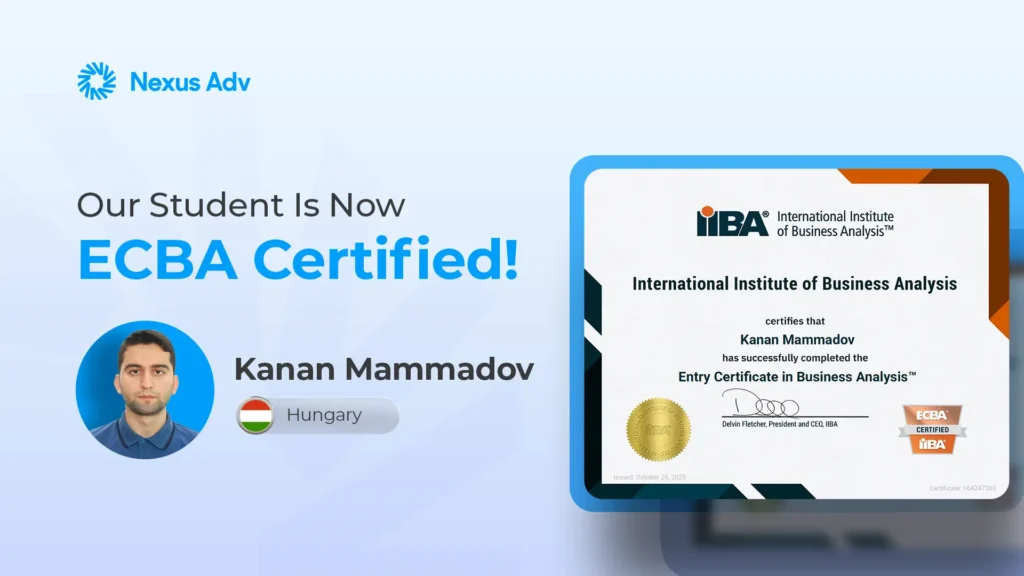
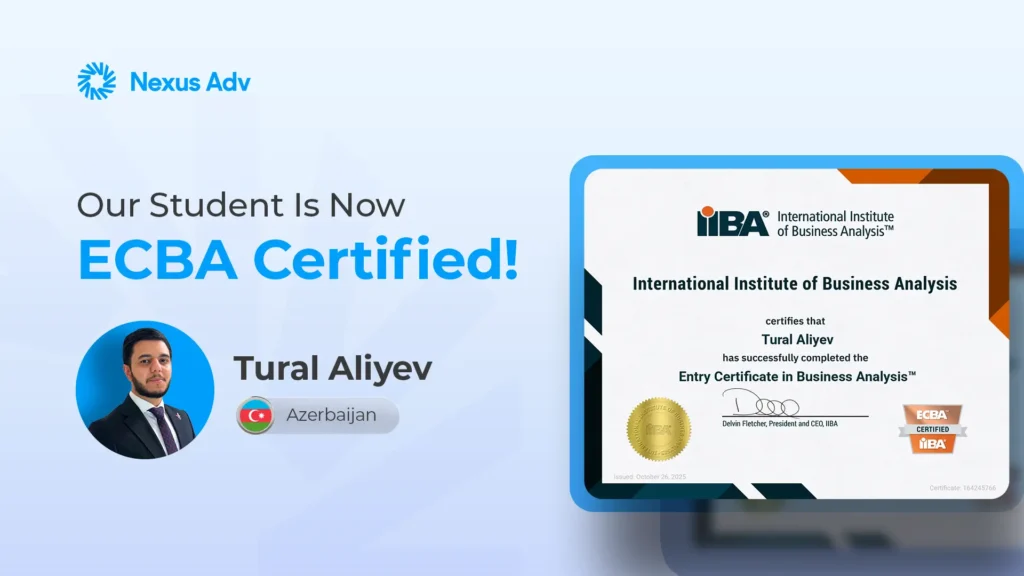
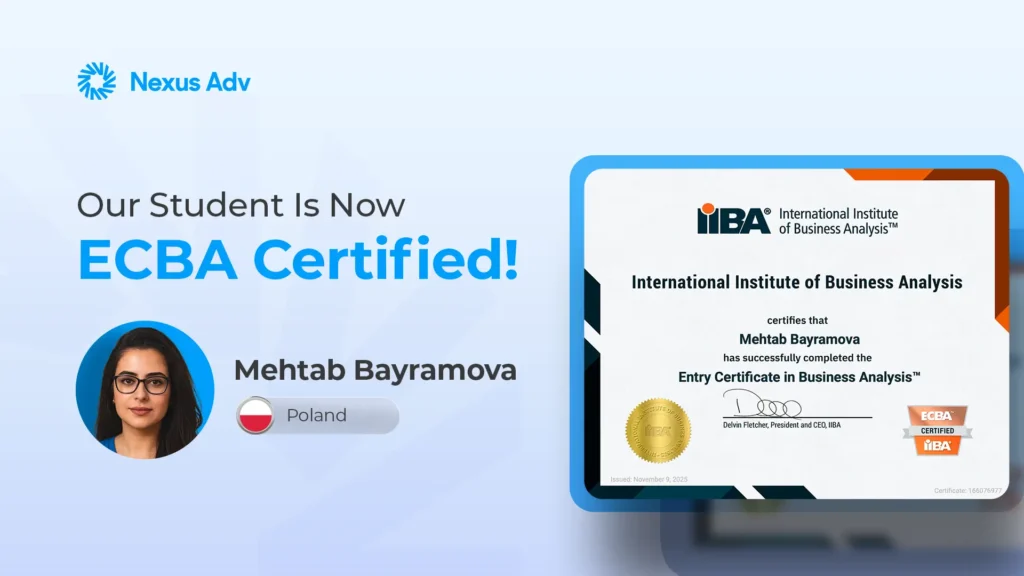
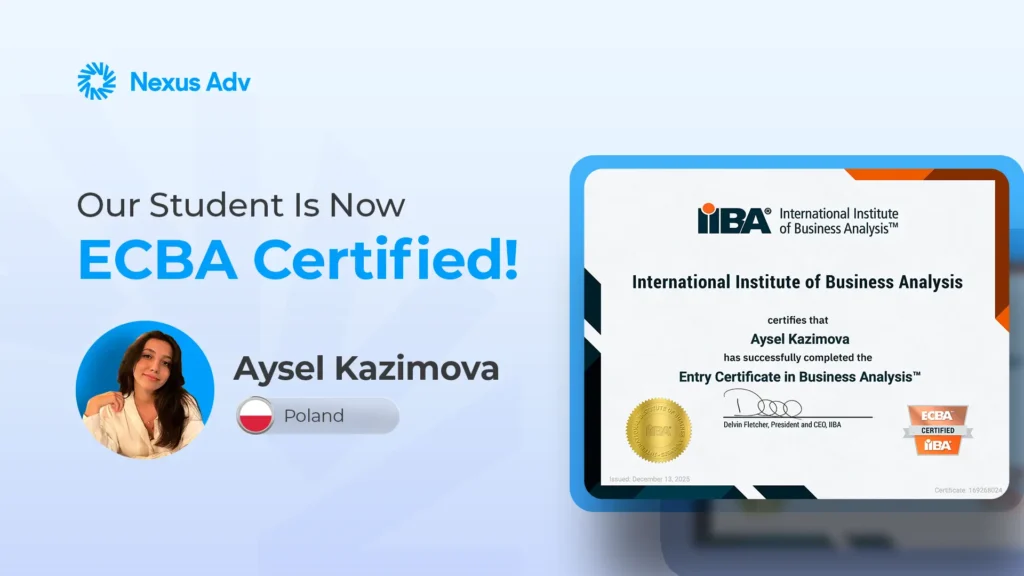
ECBA Certified Students
Course syllabus
Business Analysis Key Concepts
- Intro
- BA Fundamentals
- BA Mindset
- Intro to BABOK
Business Analysis Planning and Monitoring
- Techniques
- BA Planning and Monitoring Tasks
- Plan BA Approach
- Plan Stakeholder Engagement
- Plan BA Governance
- Plan BA Information Management
- Identify BA Performance Improvements
Elicitation and Collaboration
- Techniques
- Elicitation and Collaboration Tasks
- Prepare for Elicitation
- Conduct Elicitation
- Confirm Elicitation Results
- Communicate BA Information
- Manage Stakeholder Collaboration
Requirements Life Cycle Management
- Techniques
- Requirements Life Cycle Management Tasks
- Trace requirements
- Maintain requirements
- Prioritize requirements
- Assess requirements changes
- Approve requirements
Strategy Analysis
- Techniques
- Strategy Analysis Tasks
- Analyze Current State
- Define Future State
- Assess Risks
- Define Change Strategy
Requirements Analysis and Design Definition
- Techniques for Requirements Analysis and Design Definition
- Requirements Analysis and Design Definition Tasks
- Specify and model requirements
- Verify requirements
- Validate Requirements
- Define Requirements architecture
- Define Design Options
- Analyze potential value and recommend a solution
Solution Evaluation
- Techniques
- Solution Evaluation Tasks
- Analyze potential value and recommend a solution
- Measure solution performance
- Analyze performance measures
- Assess solution limitations
- Assess enterprise limitations
- Recommend actions to increase solution value
Techniques
All 50 techniques
ECBA Groups
Nijat HAJIYEV CBAP™, PMP®

Built for Certification and Career Readiness
We provide a practical, hands-on approach, offering expert guidance, real-world exercises, exam practice, and access to an exclusive learning community, all designed to help students master foundational business analysis skills and confidently achieve their ECBA certification.
Essential Business Analysis Skills
Develop the foundational knowledge and techniques needed to confidently tackle ECBA scenarios and entry-level tasks.
Interactive Practice
Gain experience through scenario-based exercises that translate theory into actionable business analysis solutions.
Learn from Industry Experts
Receive guidance from seasoned business analyst who have successfully mentored candidates toward ECBA certification.
Applied Knowledge for Careers
Use methods and approaches that reflect real workplace expectations, ensuring you’re ready to contribute from day one.
What people are saying
Frequent Asked Questions (FAQs)
Why is ECBA certification important for aspiring business analysts?
The ECBA certification is a globally recognized starting point for anyone aiming to build a career in business analysis. It proves that you understand the fundamentals of the BABOK framework and signals to employers that you are serious about developing analytical and problem-solving skills needed for business success.
Why should I invest in an ECBA certification course instead of studying on my own?
An ECBA certification training course provides a structured learning path, access to expert instructors, and real-world case studies. This guided approach helps you connect theoretical knowledge with practical application, which is critical for success in both the exam and your future projects.
What makes the IIBA ECBA certification unique compared to other entry-level programs?
The IIBA ECBA certification is internationally accredited and follows global standards in business analysis. It ensures that your skills are aligned with industry expectations, making you more competitive in the global job market and opening doors to advanced certifications later in your career.
What skills will I gain from the ECBA training course?
Through this ECBA training course, you will develop core business analysis skills such as requirement gathering, process documentation, and stakeholder communication. These skills are based on the BABOK Guide and are highly valued by employers in multiple industries.
How do ECBA practice tests help with exam preparation?
ECBA practice tests allow you to simulate real exam conditions and identify knowledge gaps. Regular practice builds confidence, improves time management, and helps you understand how to interpret and answer different types of exam questions effectively.
How many questions are on the ECBA exam and what score do I need to pass?
The ECBA exam contains 50 multiple-choice questions that must be completed within 60 minutes. While IIBA does not publish a specific passing score, aiming for at least 70 percent accuracy is generally considered a safe target.
How is the ECBA exam connected to real-world business analysis work?
The ECBA exam focuses on applying BABOK concepts to real situations. Each question tests how well you can analyze business needs, propose effective solutions, and communicate them clearly, which mirrors actual responsibilities of a business analyst.
What happens after I complete the ECBA certification course?
After completing the ECBA course, you will receive a certificate of completion and support in applying for the official IIBA ECBA exam. Our instructors guide you through the next steps so that you can confidently schedule and pass your exam.
What career opportunities can I expect after earning the ECBA certification?
The Entry Certificate in Business Analysis opens doors to roles such as junior business analyst, process analyst, and data analyst. It also serves as the foundation for higher-level IIBA certifications and helps you establish a long-term career in business analysis.